LoRA Fine-Tuning Guide for Healthcare Question & Answer Chats
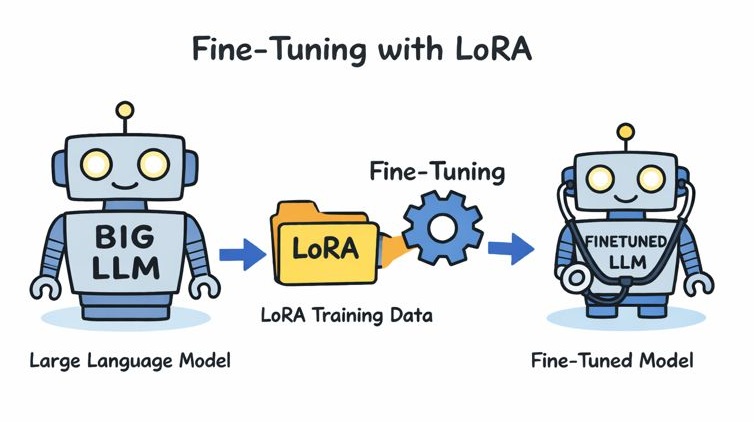
Welcome to a guide for LoRA (Low-Rank Adaptation) fine-tuning of large language models. This documentation covers everything from basic concepts to advanced implementation techniques for parameter-efficient fine-tuning (PEFT).
Educational use only
This project is for educational purposes only. It should not be construed as healthcare advice.
🎯 What You'll Learn
- LoRA Theory: Understanding the mathematics and principles behind parameter-efficient fine-tuning
- Dataset Creation: How to create and format training datasets using simple text editors
- Implementation: Step-by-step code walkthrough of a complete fine-tuning pipeline
- Safety & Ethics: How Microsoft's Phi-4 models implement responsible AI principles
🚀 Quick Start
Prerequisites
- NVIDIA GPU with ≥8GB VRAM
- Python 3.11+ environment
- Basic understanding of machine learning concepts
- Understand LoRA - Learn the fundamentals
- Check Prerequisites - Ensure you have everything needed
- Create Your Dataset - Prepare training data
- Start Training - Begin fine-tuning your model
🔬 Key Features
- Memory Efficient: Train large models with consumer GPUs using 4-bit quantization
- Fast Training: LoRA adapters train in minutes instead of hours
- Safety First: Built-in medical AI safety guidelines and ethical considerations
- Modular Design: Swap adapters without retraining the base model
- Production Ready: Complete pipeline from training to deployment
🏥 Medical AI Focus
This guide specifically addresses the unique challenges of medical AI applications:
- Safety Protocols: Preventing harmful medical advice
- Professional Boundaries: Appropriate deferral to healthcare professionals
- Regulatory Compliance: FDA and WHO guidelines for AI in healthcare
- Ethical Training: Microsoft's responsible AI principles in practice
🛡️ Built on Microsoft Phi-4
This implementation leverages Microsoft's Phi-4-mini-instruct model, specifically designed with:
- Constitutional AI training for safety
- Built-in content filters and boundary respect
- Extensive red team testing for robustness
- Alignment with responsible AI principles
Ready to start? Begin with What is LoRA? to understand the fundamentals.